


This is the season of Premier League aggro, where cheats prosper
This is the season of Premier League aggro, where cheats prosper

Sam DeanTue, November 10, 2026 at 8:00 AM UTC
0

Igor Thiago was grabbed by the shirt and shoved in the chest by Chema Andres before he reacted by trying to brush the Brighton player off with his arm, making contact with the face - Getty Images/Shaun Brooks
Here are two depressing lessons from the past few weeks of Premier League action: play-acting works, and deliberately needling your opponent could lead to significant benefits for your team.
This is becoming the season of provocation in the English top flight, where dishonesty is being routinely rewarded. The latest example came on Sunday, when Brentford’s Igor Thiago was shown a red card for “violent conduct” after a collision with Brighton midfielder Chema Andrés.
A recap of events: Andrés grips Thiago’s shirt while the Brentford forward has the ball, and then shoves Thiago in the chest. Thiago responds by brushing off Andrés with his arms. In doing so, one arm inadvertently makes contact with the Spaniard’s face. Andrés, unlike Thiago, uses this contact as an excuse to collapse to the turf in pretend agony. Thiago is shown a red card.
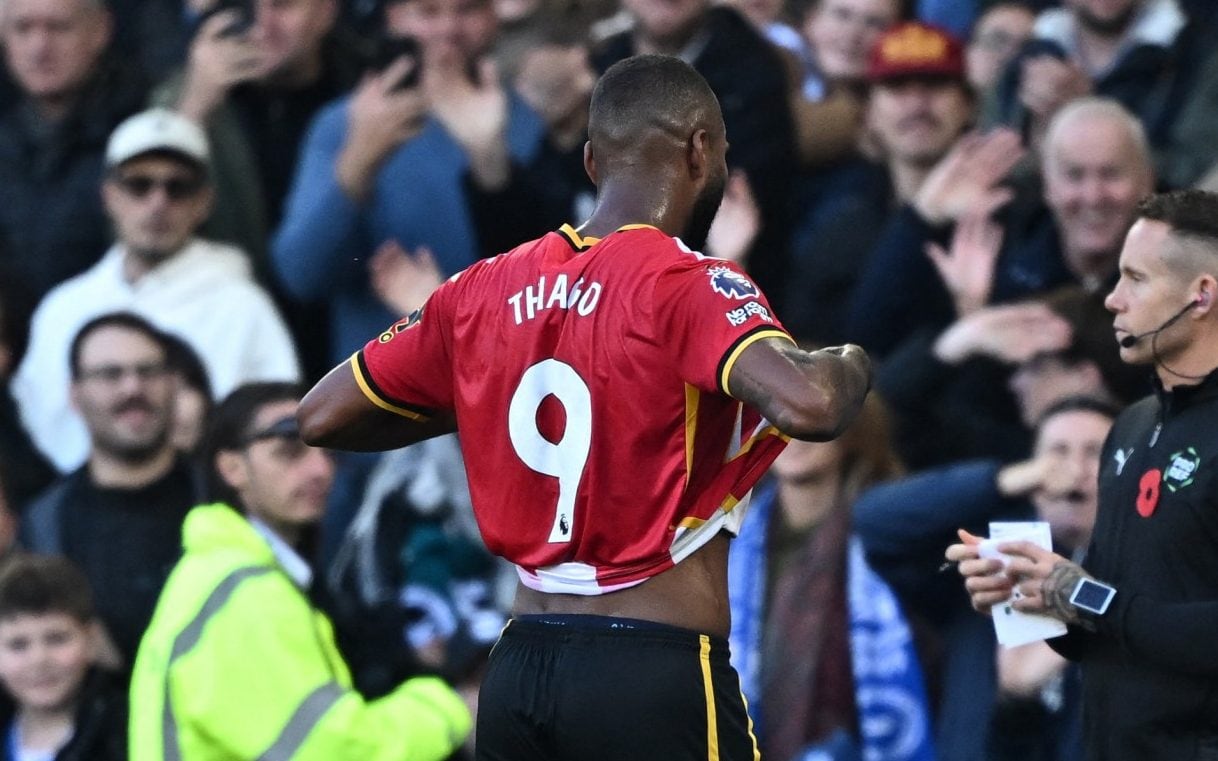
Thiago’s manager Keith Andrews felt aggrieved at his striker’s sending-off (below) - Reuters/Dylan Martinez
It continued a pattern we have seen throughout this season, when the reaction of a provoked player has often been treated as a far more serious crime than the original action itself.
Take the red card shown to Arsenal’s Max Dowman last month. He was dismissed for “violent conduct” after attempting to dislodge his leg from an aggressive scissor tackle by Fleetwood Town’s Harrison Neal. Only one player was at risk of being hurt in that situation, and it was not the player who was sent off. The lesson from the game to Dowman, 16, is bleak: next time, he should roll around and scream to the skies, in an attempt to get the opposition player in trouble.
There was also a red card for another Brentford player, Yehor Yarmolyuk, in their recent game against Liverpool. On that occasion, Liverpool defender Jérémy Jacquet deliberately provoked Yarmolyuk by walking directly into him while the ball was out of play. When Yarmolyuk responded by nudging Jacquet with his chest, he also made slight contact with his forehead. Down went Jacquet, crumpled on the ground as if punched by Anthony Joshua, and out came the red card. By the laws of the game, it was the correct decision. But how grim it is for the sport that this is the case.
“We have lost two games this season and both have been on occasions when we have had a man sent off,” Keith Andrews, the Brentford head coach, said on Sunday. “On both of those occasions, it’s the opposition player that has antagonised the situation, that’s been the one to provoke everything. We need to do better, but I think it’s a sad indictment of where the game’s going at times.”
Advertisement
Manchester City’s Phil Foden was also punished for reacting to violence, rather than rolling about in mock agony, in September’s Manchester derby. Bruno Fernandes fouled Foden, then kicked the City player while he was on the ground. Foden’s mistake was to instinctively defend himself, rather than to scream and wail. Instead, it was Fernandes who produced the screams and wails. Foden saw red.
It has created a situation in which players are being effectively encouraged to feign injury. Those who cheat – and yes, let us be honest, this is cheating – are being rewarded. Those who do not are made to feel like fools.
Let us not forget one of the most important moments in the title race last season. When Arsenal played City in April, centre-back Gabriel Magalhães moved his head towards the forehead of Erling Haaland as the two men clashed. Haaland stayed on his feet, and Gabriel subsequently avoided a red card. “If I go down like any other guy, it’s a red card,” Haaland said afterwards, reasonably. In other words, his honesty kept Gabriel on the pitch for the rest of that match and for the title run-in.

Gabriel Magalhaes did not receive a red card for this because Erling Haaland stayed on his feet - Getty Images/Alex Livesey
Similarly, Liverpool striker Alexander Isak declined to plunge to the floor when his shirt was pulled in the penalty area against Arsenal last weekend. “Honestly, yes, we have to tell them to go down because they’re not going to call it otherwise,” Andoni Iraola, the Liverpool head coach, said about the incident.
This is not to say that the referees are entirely to blame. To a large extent, their hands are tied by the laws of the game, especially with regard to off-the-ball scuffles. The laws state that a player striking an opponent on the face with the arm when not challenging for the ball is guilty of violent conduct. Andrés made a mountain out of a molehill, but there was still a molehill.
Common sense, though, can be applied. In that meeting between Liverpool and Arsenal, Alexis Mac Allister attempted to trick Andy Madley, the referee, into showing Noni Madueke a red card after the two players touched foreheads. Madley, to his credit, did not fall for Mac Allister’s embarrassing theatrics.
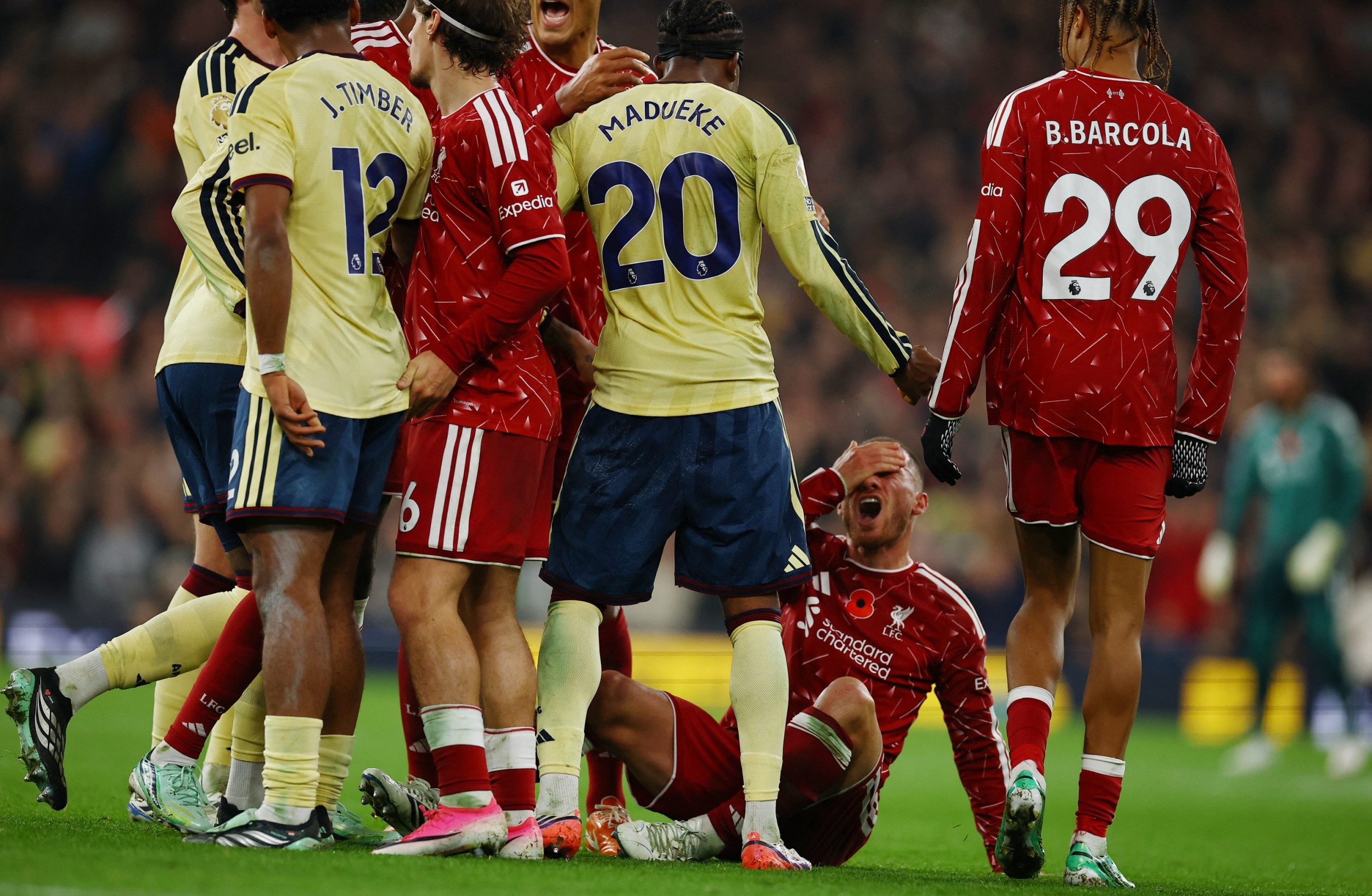
When Arsenal played Liverpool last week Alexis Mac Allister fell to the ground theatrically after Noni Madueke touched his forehead - Reuters/Phil Noble
What can be done? Within the laws of the game as they are, not a huge amount. It could potentially be argued that these players who exaggerate and collapse to the turf are guilty of deceiving the referee, which would lead to a caution for unsporting behaviour. This author would argue a more severe punishment would be required if football wants to be rid of this nonsense. If it were allowed within the laws, red cards for both the instigator and the responder would send a strong message to the wider game.
The blunt truth of the matter is this: the sight of a fully grown professional athlete writhing on the floor at the slightest contact is usually far more of a blight on the sport, and far more damaging to football’s reputation, than the supposedly “violent” act which triggered such a reaction. Viewers across the world will undoubtedly have been more offended by Andrés’s actions on Sunday than by Thiago’s, and yet it is the Brentford forward who will miss three matches. The same was true of Fernandes and Foden earlier in the campaign. Deception and deviousness, it seems, have become necessary attributes in the modern game.
Source: “AOL Sports”
